
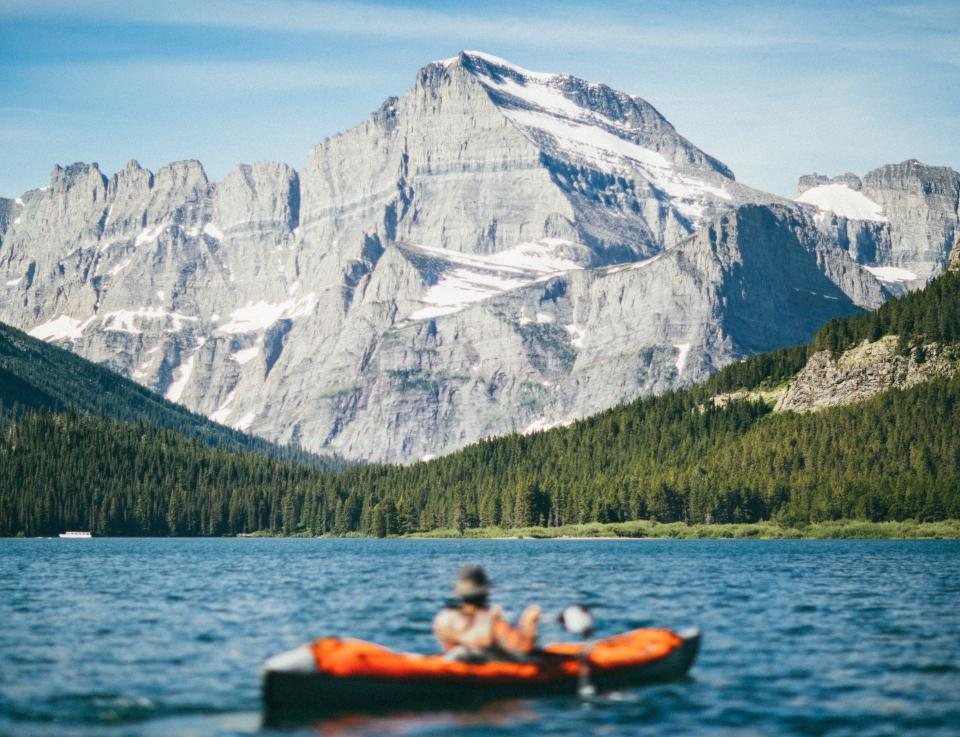
There is a particular silence that comes with a canoe loaded for a night out. The car is behind us, the paddle dips, and everything we need for the next twenty-four hours sits between the gunwales. Canoe camping is the gentlest form of wilderness travel: the boat carries the weight, the pace is slow, and a lake with a handful of islands can feel remote a kilometre from the road. This guide walks through a first overnight, from choosing the lake to packing the boat, so that the first trip is memorable for the right reasons.
Choosing the lake
A first overnight belongs on a small or medium lake, ideally under five kilometres long, with a launch point, a designated campsite within an hour or two of paddling, and shoreline we could reach in minutes if the weather turned. Large lakes are the canoeist’s ocean. A fetch of ten kilometres, the distance wind travels over open water, can raise waves of half a metre in an afternoon breeze, enough to swamp a loaded open boat. Small lakes, river-connected chains of ponds, and the sheltered arms of bigger lakes are where we learn.
In most countries with a canoe tradition, backcountry campsites on public land are managed through a permit or reservation system, sometimes with a small nightly fee and a limit on group size. We check the rules for the area before we go, book where booking is required, and note whether fires are allowed. Some regions ban open fires entirely in dry months. A well-chosen first lake has a marked site with a level tent pad, a fire ring or a place for a stove, and a landing where a loaded canoe can be unloaded without a swim.
The boat and how it is loaded
A tandem tripping canoe of 4.8 to 5.2 metres carries two adults and their gear for several days with ease. For a single night, almost any open canoe of that length will do. What matters is how it is loaded. Heavy items go low and central: the food barrel or the largest dry bag sits on the floor between the seats, just aft of the centre thwart. Lighter, bulkier bags fill the ends. The goal is a boat that sits level in the water, with the bow perhaps two or three centimetres higher than the stern so it does not plough into waves.
Everything is packed in waterproof bags or barrels, and everything is tied in. If we capsize, an untied load floats away in a dozen directions; a tied load stays with the boat and can be recovered. Two large dry bags of 60 to 80 litres, one per person, plus a rigid barrel for food, is a classic and sufficient set-up. We keep a small day bag within reach containing water, snacks, sun protection, the map and a rain jacket.
Both paddlers wear a buoyancy aid, and each boat carries a spare paddle, a bailer, a throw bag with 15 metres of floating line, and a whistle. These four items are required by law in many jurisdictions and are sensible everywhere.
What to bring for one night
- Shelter: a tent with a full fly, a sleeping mat and a sleeping bag rated at least five degrees below the forecast overnight low.
- Kitchen: a small stove and fuel, a pot, a mug, a spoon, a lighter and a backup, and a water filter or purification tablets.
- Food: a hot dinner, breakfast, lunch for both days, and a full day of extra snacks in case wind holds us on shore.
- Clothing: quick-drying layers, a warm mid layer, a rain shell, a hat, and a complete dry set for camp kept in its own bag.
- Safety and navigation: a first-aid kit, a headlamp, a paper map in a waterproof case, a compass, a repair kit with tape, and a charged phone.
Cotton has no place in a canoe. It absorbs water, dries slowly and pulls heat from the body. We wear synthetics or wool, and we put the dry camp clothes on only once the boat is unloaded and the tent is up.
Paddling loaded and staying close to shore
A loaded canoe is slower to turn and slower to accelerate, but it is also more stable and tracks better in a straight line. A relaxed pace of four kilometres per hour is realistic, so a campsite five kilometres away is a comfortable ninety minutes with a break. We paddle along the shore rather than straight across open water, adding distance but keeping land within a few hundred metres at all times. Crossings of more than 500 metres are for calm mornings, never for afternoons when wind on most lakes is strongest.
Wind is the decision-maker in canoe camping. If whitecaps are visible, we stay on shore, and the extra day of snacks is why. Early starts are the canoeist’s habit: the hours after dawn are usually the calmest of the day, and a paddle finished by mid-morning avoids most of the weather. Thunderstorms are the exception to every rule. At the first rumble we land, move away from the water and the tallest trees, and wait thirty minutes after the last thunder before we launch again.
Camp on the shore
We land, unload, and pull the canoe fully out of the water, turning it over and tying the painter to a tree. Boats have floated away overnight when a lake rose or a wind shifted, and a canoe camper without a canoe has a long walk. The tent goes on the established pad; we do not clear a new one. Food, toiletries and anything scented are stored away from the tent, hung from a branch at least three metres up and one metre out from the trunk, or sealed in the barrel and left well away from camp, depending on local wildlife guidance.
Water from a clear lake is generally treated before drinking; a filter is quickest, and boiling for one minute is the reliable alternative. We wash dishes and ourselves at least 60 metres from the water, and we carry out everything we brought in, including food scraps and the ash from a fire if we had one. A site left cleaner than we found it is the only tradition that matters.
The morning after
The second day is the reward. We wake to still water and mist, pack slowly, and load the boat exactly as before. Before we push off we check the wind, the sky, and the map once more, and we tell each other the plan: which shore, which landing, where we stop if it blows. The paddle home feels shorter than the paddle out; it always does. Somewhere along the way the idea of two nights, then three, will arrive on its own. That is how a first overnight turns into a lifetime of lakes.