
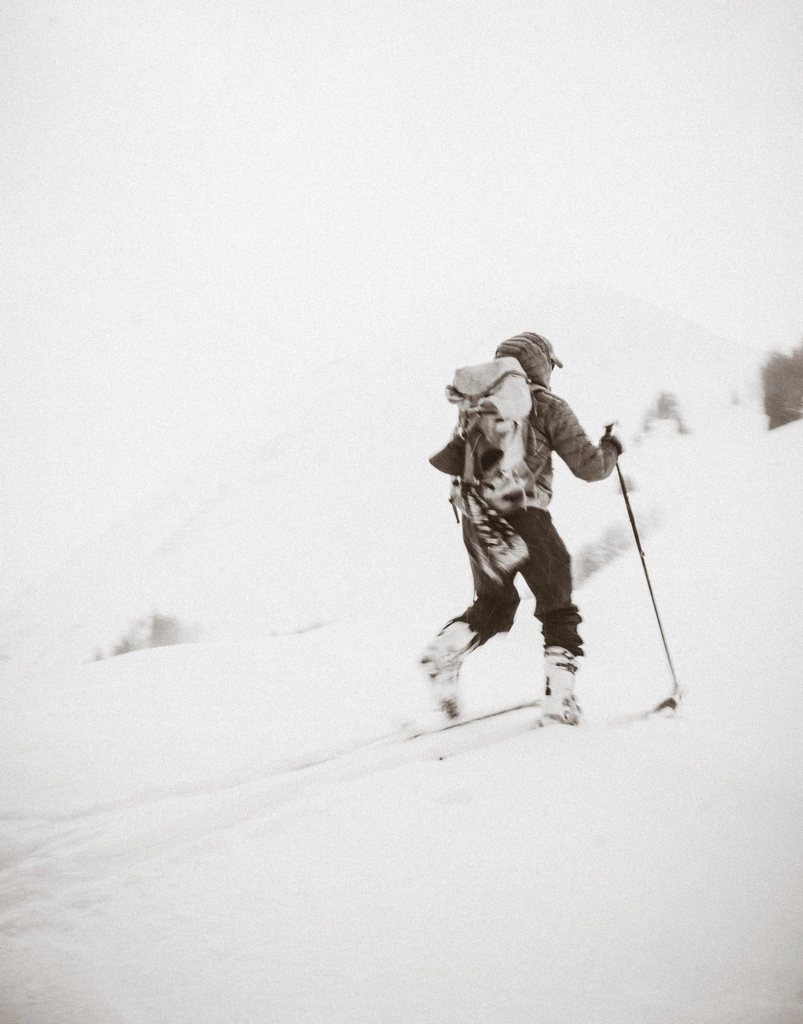
Cross-country skiing has two disciplines that share a trail network, a rental counter and a season, and almost nothing else. Classic skiing moves in parallel grooves with a motion that resembles a gliding walk. Skate skiing uses a flat, wide lane and a motion borrowed from ice skating. They are parallel paths, and which one you start on depends on your goals, your fitness and the trails near you. This article compares the two honestly, then walks through what the first three lessons in each usually contain, so that you know what you are signing up for.
The two techniques in plain terms
In classic skiing, the skis point straight ahead in a set track about 20 centimetres apart. Grip comes from a zone under the foot that is either waxed, patterned like fish scales, or covered with a strip of mohair skin; when you press down and back, that zone holds the snow, and when you glide on the other ski it releases. The rhythm is one ski, then the other, with poles alternating in a motion called diagonal stride. It works at any speed, including very slowly, which is why it is the discipline for a first hour.
In skate skiing, the skis are shorter, entirely smooth underneath, and used in a V. You push off the inside edge of one ski while gliding on the other, and both poles plant together. There is no grip zone, so if you stop pushing you stop moving, and on a hill you slide backwards. The technique is faster and more athletic, and the learning curve is steeper in the first two hours and flatter afterwards.
Which to choose first
Start classic if you want to be moving comfortably within an hour, if you are returning to sport after a long gap, if the trails near you are narrow forest trails with set tracks but no wide skating lane, or if you simply like the idea of a long slow tour with a thermos in the pack. Start skate if you already skate on ice or inline, if you come from running or cycling and want a hard aerobic workout, or if you find the classic grip-and-glide timing frustrating and prefer a technique with an obvious cause and effect.
A practical note on equipment: classic skis are sized to your body weight so that the grip zone touches the snow only when you press, and a rental shop will test this by sliding a card under the ski while you stand on it. Skate skis are shorter, roughly to your chin, with poles to your lips or nose. Classic poles reach the armpit. Renting for the first block of lessons makes sense because a shop will fit the stiffness properly.
Lesson one: standing, falling and the flat
Whichever discipline you pick, the first lesson happens on the flat and starts with the boring parts. You learn to clip in and out without help, to turn around on the spot by stepping the tips in a star, and to fall sideways and get up by bringing the skis parallel below you on the slope. Falling is not a failure; instructors ask you to do it on purpose so that the first real fall is a known quantity.
In classic, the rest of the hour is spent shuffling without poles. You keep your weight on one ski at a time and try to feel the moment the grip zone bites. Most people can glide a few metres per stride by the end, and the mistake to expect is standing with weight split evenly between the skis, which makes both slip. In skate, the first hour is also without poles: you learn the V position, push off one edge, and try to balance the glide on a single ski for a full second. Expect to feel like a newborn deer.
Lesson two: adding poles and a small hill
The second lesson introduces the poles and the timing between arms and legs. In classic this is diagonal stride: right arm forward with left leg, and the pole plants beside the boot, not out in front. The most common fault is punching the pole too far forward, which pulls your weight back and kills the grip. The instructor will then take you to a gentle rise and teach the herringbone, tips wide and edges in, and on the way down the snowplough, which works in classic skis just as it does on alpine skis, only with less edge.
In skate, lesson two typically teaches the first of the gears, often called V1 or offset: both poles plant together on one side, every second push, and it is the technique that gets you up hills. You also learn the free skate without poles on downhill sections, and how to stop, which in skate is a wider snowplough with the poles held out of the way.
Lesson three: a real loop
By the third session most schools take you out on a short groomed loop of 3 to 5 kilometres and let you link everything. The teaching shifts from mechanics to pacing. In classic you learn double poling on the flats and gentle downhills, where both poles plant together and the legs rest, and you start to feel when the snow is slower or faster and adjust your stride. In skate you add the second gear, often called V2 or one-skate, where you pole on every push; it is fast and tiring, and most beginners can hold it for only a few hundred metres at first.
The loop is also where trail etiquette becomes concrete. Classic skiers stay in the tracks and step out to let faster skiers pass. Skaters keep off the set tracks entirely. Everyone yields to the person coming downhill, and everyone moves off the trail before stopping to adjust a glove.
What to expect from your body
Cross-country skiing uses almost every large muscle, which is why the first week produces soreness in places you had forgotten: triceps from poling, hip abductors from skating, lower back from the forward lean. Sessions of 60 to 90 minutes are plenty at the start. Drink more than you think you need because cold, dry air pulls water from your lungs with every breath, and eat something during any outing longer than an hour.
Dress for the discipline. Skaters generate heat quickly and often ski in a single thin layer under a windproof top at minus 10 degrees Celsius. Classic tourers move more slowly and want a warmer mid-layer and a hat that covers the ears. Both need thin gloves rather than bulky mitts so that the poles can be gripped and released on every stroke, which is the detail that separates skiing from stabbing the snow.
After three lessons in either style you will not be fast, but you will be independent, and independence is the goal. From that point the trail network is open to you, the season is long, and the choice of whether to add the second discipline can wait until you have worn out the first.