
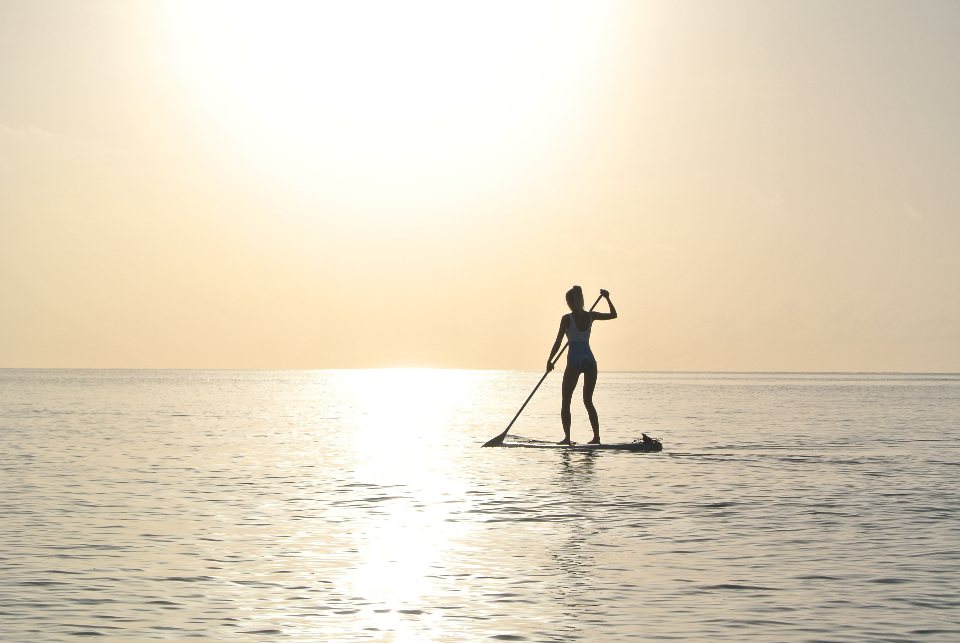
Stand-up paddleboarding is the easiest way most of us will ever get onto the water. Ten minutes of instruction, a wide board and a calm lake, and we are standing, moving and grinning. That accessibility hides a real hazard: the same board that feels like a floating carpet on a windless morning becomes a sail the moment the breeze picks up, and every summer people are blown offshore on boards they could not paddle back. This guide covers what a beginner needs to know: how balance actually works, why wind is the whole story, and why the leash and the buoyancy aid go on before the first stroke.
Choosing a board that helps
Beginners do best on an all-round board between 3.2 and 3.5 metres long and 80 to 86 centimetres wide. Width is stability; a board narrower than 76 centimetres is designed for speed and will punish an unsteady stance. Volume, measured in litres, tells us how much weight the board floats comfortably. As a rule of thumb, a beginner wants a volume in litres of at least twice their body weight in kilograms, so an 80 kilogram paddler looks for 160 litres or more. Inflatable boards dominate the beginner market because they pack down, resist knocks and are forgiving to fall on.
The paddle should stand about 15 to 25 centimetres taller than we are. Held correctly, the blade angles forward, away from us, which feels wrong to almost everyone on the first day and is right nonetheless.
How balance really works
Standing on a board is not about stiff legs and a fixed gaze at our feet. The stable position is feet parallel, roughly shoulder width apart, either side of the carry handle at the centre of the board, knees soft, hips loose and eyes on the horizon. Looking down is the most common cause of a fall because it drops the head, and the body follows. The knees act as suspension: every small wave is absorbed by bending, not by fighting.
The paddle is a third leg. A blade planted in the water gives us something to lean on, so the moment we feel unsteady the answer is to paddle, not to freeze. Starting on the knees for the first hundred metres, then rising one foot at a time from a kneeling position, gives the body time to feel how the board responds. Most beginners are standing within fifteen minutes and fall two or three times in the first hour. Falling is part of the curriculum: we fall away from the board, flat, never head first, and we climb back on from the side, pulling on the far rail while kicking.
The forward stroke is a lesson in itself. We reach forward, plant the whole blade, and pull with the torso rather than the arms, keeping the shaft vertical so the board runs straight. Three to five strokes on one side, then switch.
Wind is the whole story
A standing paddler presents a large surface to the wind, and the board itself, with its rocker and rails, catches more than a kayak. The effect is dramatic. In winds above about 15 kilometres per hour, roughly force three, a beginner paddling into the wind may make no progress at all, and turning to go downwind means being carried faster than expected. On a lake this means a long walk back along the shore. On the sea it means being blown away from land, sometimes at a speed we cannot match.
Offshore wind is the danger to memorise. When the wind blows from the land toward open water, the beach feels calm, the water near shore looks flat, and everything appears perfect. Twenty metres out, beyond the shelter of trees and dunes, the wind strengthens and the board starts to drift. The further we go, the harder it becomes. Coastal rescue services report that offshore winds are the single most common factor in paddleboard incidents. The rule for a first season is absolute: no paddling on the sea in offshore winds, and no paddling anywhere if the forecast is above force three.
The safe way to plan a session is to paddle into the wind first, while we are fresh, and return with it behind us. If the wind builds unexpectedly, we kneel or sit to reduce our profile and paddle home with short, quick strokes, keeping close to the shore.
The leash and the buoyancy aid
The leash is a coiled or straight cord connecting our ankle or calf to the board. It exists for one reason: the board is our flotation, and the moment we fall off in wind or waves, an unleashed board travels faster than we can swim. Every season people drown within sight of a board that drifted just out of reach. The leash stays on from the moment we step onto the board until we are back on the beach.
The type of leash depends on the water. On lakes, calm sea and other flat water, a coiled ankle leash is standard. On rivers, in any current, an ankle leash becomes a trap if the board snags and the water pins us, so a quick-release waist leash is the only safe option. If we ever paddle moving water, we learn to release it with one hand without looking.
A buoyancy aid completes the kit. A waist-belt inflatable is popular with paddleboarders because it does not restrict movement, but it has to be pulled manually and we must practise doing so. A conventional foam buoyancy aid is simpler and works when we are cold, shocked or injured. For a first season, we recommend the foam vest.
A first-session checklist
- Flat, sheltered water: a small lake, a slow river above any weir, or a bay in onshore wind.
- Forecast checked for wind speed, direction and the next three hours.
- Board inflated to the marked pressure, fin fitted, leash attached and tested.
- Buoyancy aid on, a whistle clipped to it, phone in a waterproof pouch on our body, not the board.
- Someone on shore who knows our route and when we plan to be back.
Cold water and the first season
Falling in is inevitable, so the water temperature decides what we wear. Above 20 degrees Celsius, shorts and a rash vest are fine. Between 12 and 20 degrees, a wetsuit or neoprene layers keep the first swim from becoming a problem. Below 12 degrees, cold water shock can cause a gasp and a panic that has nothing to do with swimming ability, and only a full wetsuit or drysuit is appropriate. We dress for the water, not for the sunshine on the beach.
By the end of a first summer, a paddler who respects these rules has covered many kilometres, fallen in a dozen times, and learned to read the surface of a lake for the dark ripples that mean wind is coming. That is the foundation for everything the sport offers next: touring, surf, downwind runs and long river days. It all starts with a wide board, a leash, and a forecast we actually read.
Read next: Canoe on a Lake for the First Time: What to Expect and How to Prepare