
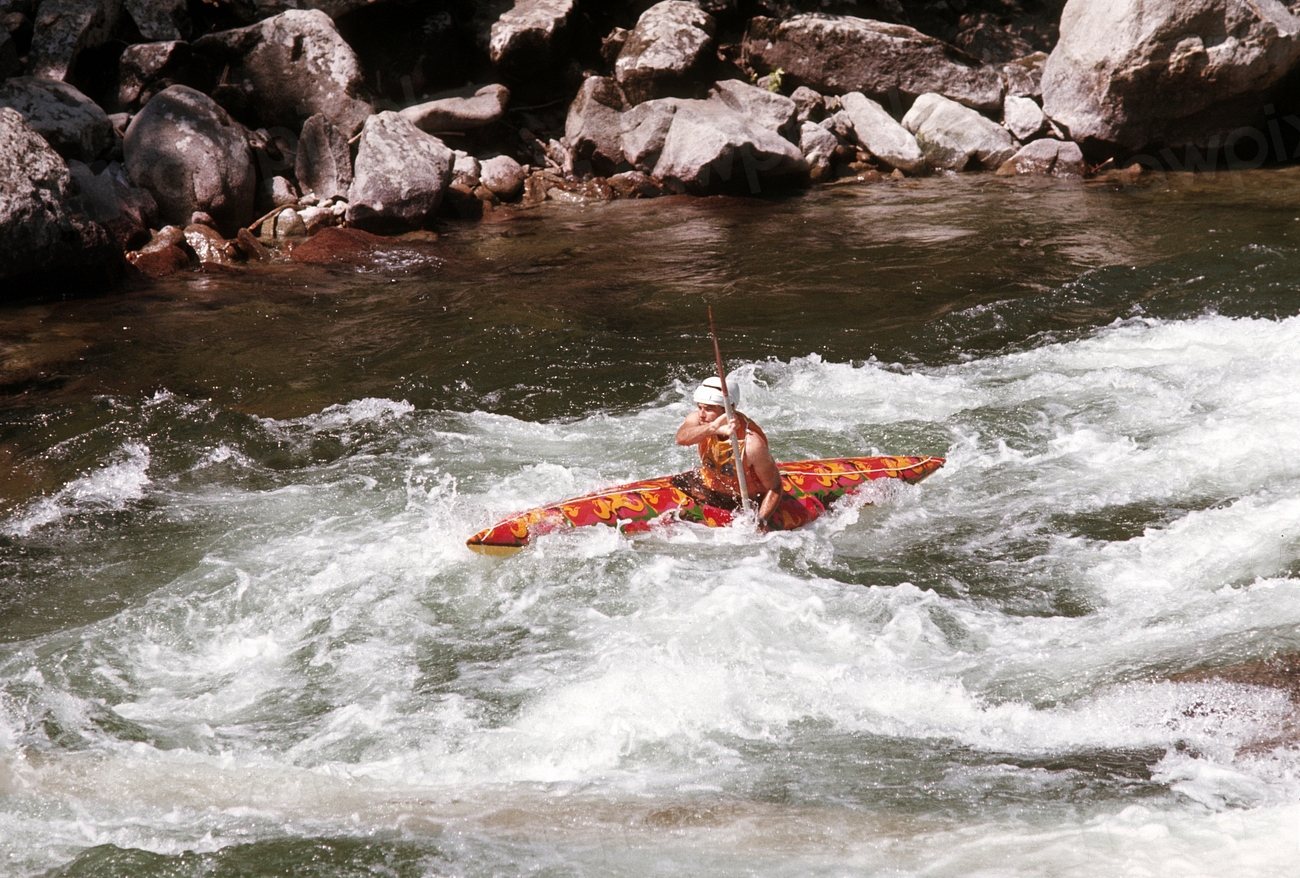
Whitewater has a language of its own, and the first thing a beginner hears is a number. A grade two river, a grade three drop, a grade four rapid we will portage. The grading scale is the map of the sport, and understanding it, along with the strange but essential skill of swimming a rapid, is what turns moving water from something frightening into something readable. This guide explains the grades, describes what a first whitewater lesson actually involves, and sets out the safety habits that every paddler keeps for life.
The international grading scale
Rivers are graded on a scale from one to six, applied to individual rapids or to a whole section. Grade one is moving water with small waves and no real obstacles; a competent flatwater paddler can handle it with a little instruction. Grade two brings regular waves up to about half a metre, clear channels that are obvious from the boat, and small drops. It is the classic beginner grade, and most of a first season is spent here. Grade three has irregular waves of up to a metre, stronger currents, rocks and holes that require moves to avoid, and channels that often need scouting from the bank. It is the point at which real technique is required and the point at which a beginner should be under instruction.
Grade four is long, powerful and technical, with consequences for a mistake; grade five is extremely difficult and dangerous; grade six is the limit of what is considered runnable. Grades are not fixed. A rapid that is grade two in summer can become grade three or four after heavy rain, and a river’s guide description always refers to a particular water level. Learning to check the gauge for a river and to relate the reading to the grade is one of the first skills a whitewater paddler acquires.
The boat, the kit and why it is different
Whitewater kayaks are short, between two and three metres, with a rounded hull and plenty of rocker so they turn instantly. They feel wobbly and slow compared with a touring boat, and that is intended. Inflatable boats and open canoes fitted with airbags are also used on easier rivers. Whatever the boat, the kit list is longer than for flat water: a helmet is mandatory, a buoyancy aid with a higher buoyancy rating than a sea-kayak vest, a spray deck that fits tightly, footwear that stays on and protects the sole, and a wetsuit or drysuit because immersion is not a possibility but a certainty. A throw bag, a knife, a whistle and a first-aid kit are carried within the group.
Nothing is tied to the body or the boat that could snag. Long loose cords, jewellery and open-toed sandals have all caused serious entrapments. The habit of checking each other’s kit before launching, called a buddy check, starts on day one.
Swimming a rapid
Every whitewater paddler swims, especially in the first season, and swimming safely is a skill taught before anything else. The position is called defensive swimming: on the back, feet downstream and up near the surface, toes visible, arms out for steering, head up to see the river. Feet stay high because the single greatest danger in moving water is foot entrapment. If we stand up or let a foot drop in fast water of knee depth or more, it can wedge between rocks, and the current then pushes the body over. We never try to stand until we are in calm, shallow water where the current is gentle.
From the defensive position we use the arms to angle toward the bank, and when the water is calmer we roll onto the front and swim hard for the eddy, the pocket of slow or reversing water behind a rock or a bend. Aggressive swimming, face down and fast, is used to cross a current or catch an eddy; defensive swimming is for riding out waves and avoiding rocks. We hold onto the paddle if we can and let the boat go if it pulls us toward danger; boats are recovered later.
The group is part of the rescue. A swimmer looks and listens for a thrown rope, grabs the rope rather than the bag, holds it over the shoulder while lying on the back, and lets the rescuer swing them into the bank. A first lesson on a grade one section includes an intentional swim precisely so that the first real swim, on a grade two rapid a few weeks later, is a routine event rather than a shock.
What a first lesson looks like
- A morning on flat or barely moving water learning the wet exit, the forward stroke, the sweep and the low brace.
- Ferry gliding: crossing a gentle current at an angle without being swept downstream.
- Breaking in and out: leaving an eddy into the current with an edge and a lean, then catching the next eddy below.
- The defensive swim, a throw-bag rescue and a towed boat recovery, all in a safe pool below a small rapid.
- Running two or three grade one to two rapids with an instructor demonstrating the line first.
Most introductory courses run over two days, and the second day usually descends a short section of grade two river of three to eight kilometres. The rolling skill, righting a capsized kayak without leaving it, is often started in a swimming pool over the winter and is not needed for the first river days. The wet exit and swim are enough.
Reading the river from the boat
Whitewater is a lesson in seeing. A downstream V of smooth water points to the deepest, clearest channel. An upstream V marks a rock just under the surface. A horizon line, where the river simply disappears ahead, means a drop we must scout from the bank before we commit. Holes, where water pours over a rock and recirculates behind it, are avoided in a first season entirely. Strainers, fallen trees with current flowing through their branches, are the one hazard we treat as absolutely off limits: water goes through, boats and bodies do not, and we walk around any rapid that has one in the line.
We scout on foot whenever we cannot see the whole rapid and the pool below it. We set a rescuer with a throw bag before anyone runs a drop. We run rapids one at a time, with the group waiting in the eddy above and collecting in the eddy below. These habits are slow, and they are why whitewater paddling in a well-run group is far safer than its reputation suggests.
Where the first season leads
A beginner who spends a season on grade two rivers, under instruction at first and then with an experienced group, arrives at the following spring with a reliable roll, a calm swim and an eye for water. Grade three then becomes a realistic goal, and the rivers of a whole region open up. The only rule that never relaxes is this: we paddle the grade the weakest member of the group can swim, not the grade the strongest can run.
Read next: Kayak Paddle Length: How to Choose the Right Size Before You Buy