
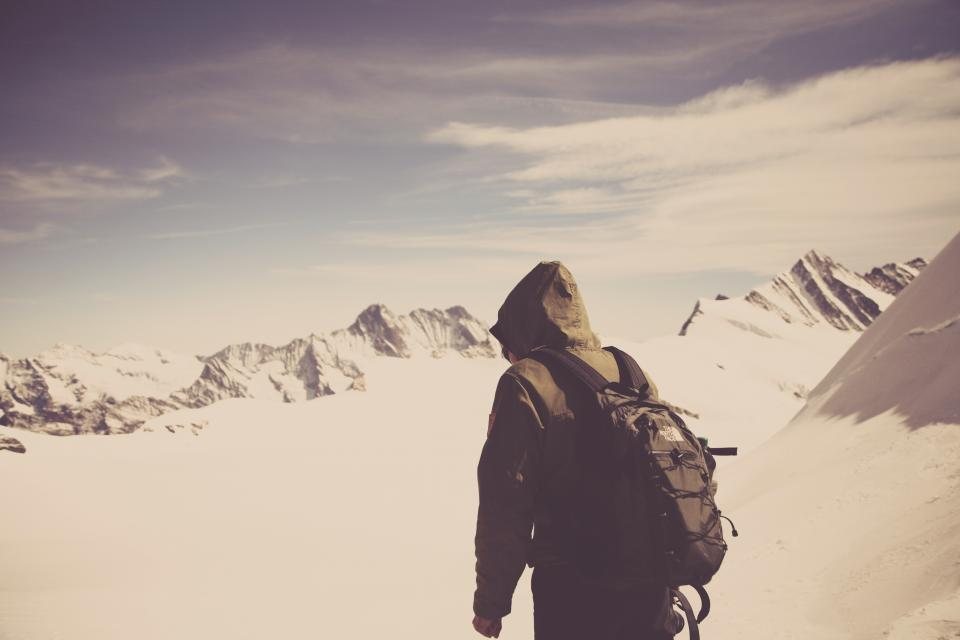
The question we hear most from people about to start an outdoor sport is some version of “am I fit enough?” The honest answer is that for a first season, almost everyone is, provided the outings are chosen sensibly. But there is a difference between being able to survive an afternoon and being able to enjoy it, and that difference is what we call a base. A base is not a training programme. It is a modest, general level of endurance, strength and mobility that lets you learn technique instead of fighting fatigue. Here is what it looks like, how to know if you have one, and how to build it in eight to twelve weeks without a gym.
The three parts of a base
The first part is aerobic endurance: the ability to keep moving at a conversational pace for two to three hours. Every sport we cover draws on it. Snowshoeing, cross-country skiing and kayaking are almost entirely endurance activities at beginner level. Even climbing, which looks like a strength sport, is limited for beginners by the endurance of the forearms and the ability to recover between routes.
The second part is general strength, with an emphasis on the trunk and the hips. Paddling, skiing and balancing on a board all transmit force through the core. A weak trunk means a sore lower back after an hour on the water and poor balance on skis. Nobody needs heavy weights for this; body-weight work is enough.
The third part is mobility: enough range in the hips, shoulders and ankles to adopt the positions the sport asks for. Sitting in a kayak for two hours requires hamstrings that tolerate a bent-forward position. Climbing requires hips that open sideways. Skate skiing requires ankles that flex. Mobility is the part beginners neglect most, and the part that causes the most niggling injuries.
A simple self-test
You can measure your base in an afternoon with three tests. For endurance, walk briskly on undulating ground for 90 minutes without stopping. If you can talk in full sentences throughout and feel tired but not wrecked the next day, your endurance base is adequate for a first season in any of the eight sports. If you need to stop or cannot talk, that is the first thing to build.
For strength, hold a front plank for 60 seconds, do 10 slow squats to a depth where the thighs are parallel to the ground, and hang from a bar or a solid branch for 20 seconds. These are modest targets. Meeting them means you can hold a paddling posture, control a descent on snowshoes and grip a climbing hold without your body being the bottleneck.
For mobility, sit on the floor with legs straight and reach toward your toes; touching the shins is enough. Then squat fully with heels on the floor and hold for 20 seconds. If either is impossible, add ten minutes of daily stretching to whatever else you do, and expect noticeable change within four weeks.
Building the base in eight to twelve weeks
The plan is deliberately plain. Three sessions a week, none longer than an hour except one weekend walk, and no equipment beyond shoes.
- Two weekday sessions of 30 to 45 minutes: brisk walking, easy cycling or easy swimming, at a pace where you could hold a conversation. This is the endurance work, and the temptation to go harder is the main thing to resist.
- One weekend outing of 90 minutes to three hours: a walk on varied ground, extending by 15 to 20 minutes each week. By week eight this is a three-hour hill walk, which is the effort profile of a beginner day in any sport we cover.
- Twice a week, 15 minutes of strength: planks, squats, lunges, push-ups against a wall or bench, and hanging from a bar. Two or three rounds, stopping well short of failure.
- Daily, ten minutes of mobility: hamstrings, hips, calves and shoulders, held gently, never bounced.
Progress comes from consistency, not intensity. A beginner who completes this plan at an easy pace for ten weeks arrives at the first outing with roughly the base of someone who has practised the sport recreationally for a season.
What each sport asks in addition
A general base covers most of the ground, but each sport has one specific demand worth preparing. For kayaking and paddleboarding, it is rotational strength through the trunk; add slow torso twists holding a light object. For snowshoeing, it is the hip flexors, which lift a heavier foot with every step; add step-ups onto a low box. For cross-country skiing, it is the shoulders and triceps, which drive the poles; add gentle dips on a bench. For climbing, it is finger and forearm endurance; add dead hangs, and be patient, because tendons adapt over months, not weeks. For open-water swimming, it is cold tolerance rather than fitness; add short cool showers and, once water is above 12 degrees, brief supervised dips of two to five minutes. For orienteering, it is the ability to run or walk fast on rough ground while thinking; add sessions on trails rather than pavements. Geocaching asks for nothing beyond the ability to walk for a few hours.
What a base is not
A base is not a race preparation, and it is not a body shape. Beginners sometimes delay starting a sport until they are “fit enough” by some imagined standard, and lose a whole season to the wait. The test in this article is the standard. If you can walk 90 minutes and hold a plank for a minute, you are ready to start snowshoeing, geocaching, paddleboarding on a calm lake, or a beginner orienteering course this weekend. The sport itself will then build the rest, faster and more pleasantly than any programme.
A base is also not a guarantee against fatigue. A first full day of kayaking will leave your shoulders sore whatever you did in the preceding weeks, because the specific movement is new. That soreness is normal, peaks about 48 hours after the effort, and passes. Pain in a joint, sharp pain that changes how you move, or pain that persists beyond four days is different, and is the signal to rest and, if it continues, to seek advice.
Keeping the base through the year
Once the season starts, the sport takes over and the plan above can be reduced to a maintenance level: one weekday endurance session, one short strength session and the daily mobility. Between seasons, restore the full plan for the six weeks before the next sport begins. Many of our readers rotate two sports, one on snow and one on water, and find that the base built for one carries over almost entirely to the other. That is the quiet advantage of a general base: it belongs to you, not to the sport, and it makes every new activity easier to begin.