
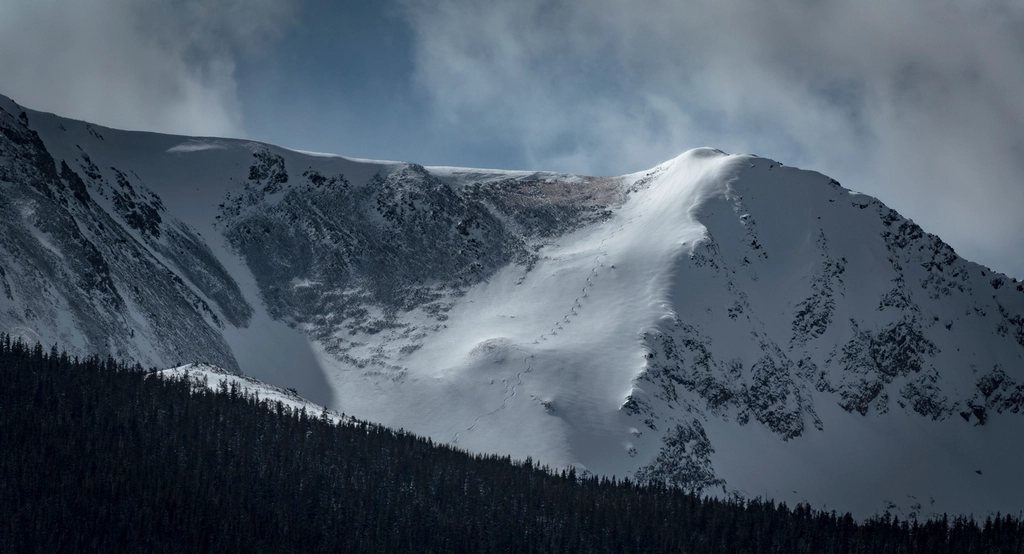
Snowshoers are the group most likely to walk into avalanche terrain without knowing it. Skiers and snowboarders hear about avalanches from their first lesson, because their sport is built on slopes. Snowshoeing is marketed as walking, and walking sounds safe. Yet the moment a snowshoe route leaves a valley floor or a forest trail and climbs toward open ground, it enters the same physics that governs every slide. This article is not a substitute for a course. It is the minimum a beginner should understand before deciding whether to leave the marked trail at all, and it ends with the case for staying on it.
What an avalanche needs
A slab avalanche, the kind that injures and kills, needs three ingredients: a slope steep enough, a cohesive layer of snow sitting on a weaker layer, and a trigger. Remove any one of them and there is no avalanche. The slope is the part you control most directly. Slab avalanches release almost exclusively on slopes between 30 and 45 degrees, with the greatest number around 38 degrees. Below 30 degrees the snow rarely has enough gravity pulling on it to fracture and run; above 45 degrees it tends to sluff off in small amounts before a dangerous slab can build.
The weak layer is invisible from the surface. It might be a crust from a thaw a month ago with loose sugary crystals beneath it, or a layer of surface frost buried by the next storm. The trigger is often the victim. In accidents involving people, the majority of slides are released by the weight of a person in the group or by someone above them.
Recognising terrain from the trail
Learning to estimate slope angle is the single most useful skill for a snowshoer, and it can be practised on any hill. A 30-degree slope feels distinctly steep to walk up; on snowshoes you will be using the heel lift and kicking steps. A slope you could comfortably stroll up is likely under 25 degrees. An inclinometer, or a phone app with one, is a cheap check while you are calibrating your eye.
Two things extend the danger beyond the slope itself. The first is runout: an avalanche that starts on a 38-degree bowl above you can bury a flat meadow at its base, so the question is not only what you are standing on but what is above you. The second is terrain traps: gullies, creek beds and abrupt flats below steep ground, where even a small slide piles up deep enough to bury a person. A forest trail that follows a stream at the foot of open slopes can be more dangerous than the hillside itself.
Dense forest is generally safe, because trees anchor the snowpack and break up slabs. The word to notice is dense. If you can snowshoe between the trunks without touching them, the forest is open enough for avalanches to run through it.
Reading the day
Most mountain regions with regular winter recreation publish a daily avalanche forecast during the season, rated on a five-level scale from low to extreme. Read it before every outing that goes near open slopes, and take the rating seriously: at considerable, the middle level, natural avalanches are possible and human-triggered ones are likely on specific slopes, and this is the level at which most fatal accidents happen, because the day looks fine.
The forecast is supported by signs you can see yourself. Recent avalanches on similar slopes are the clearest warning there is. Cracks shooting out from your snowshoes, or a hollow whumpf sound as a layer collapses under you, mean the snowpack is telling you directly that it is unstable. Heavy snowfall of 30 centimetres or more in the last 24 hours, strong wind moving snow onto lee slopes, rapid warming, or rain on snow all raise the danger for a day or more. Any one of these is enough reason to keep the outing in the trees and on low-angle ground.
The equipment and what it does and does not do
Every person entering avalanche terrain carries a transceiver, a probe and a shovel, and knows how to use them. The transceiver transmits a signal that a companion’s device can follow; the probe locates the buried person precisely; the shovel digs them out. The rescue must be done by the group, because organised help almost never arrives within the roughly 15 minutes after which survival odds drop sharply.
The equipment is worthless in three common situations. One person alone has nobody to search. A group whose members have never practised a search will take far too long. And a group that trusts the equipment enough to enter terrain they would otherwise avoid has turned a safety tool into a risk multiplier. Airbag packs improve the odds of staying on the surface, but they do nothing about trauma from hitting trees and rocks, which causes a significant share of deaths.
Moving through terrain when you must
If a route genuinely requires crossing a suspect slope, the habits are simple and non-negotiable. Cross one at a time, from one safe spot to another, while the others watch from outside the slope. Do not stop in the middle. Do not gather at the bottom of a slope to wait. Choose ridges over gullies, the sides of open slopes over their centres, and slopes below 30 degrees whenever an alternative exists. Fix a turnaround time before leaving the car, and treat it as a hard rule rather than a suggestion.
Before any of that, take a course. Introductory avalanche courses run over one to three days, mix classroom work with a field day, and are open to snowshoers as readily as skiers. The field day, spent digging into the snowpack and running companion rescue drills against a clock, teaches more than any article can.
The strongest option is the simplest
For most snowshoers, most of the time, the right answer is to stay on terrain where avalanches cannot happen: valley floors, dense forest, marked winter trails maintained by parks and nordic centres, and slopes gentle enough to walk up without effort. That is not a compromise. It is where the majority of the best snowshoeing happens anyway, and it removes the problem entirely rather than managing it. Leave the marked trail only when you can name the slope angle, the forecast rating, the recent weather, and the rescue plan, and when every person with you can do the same. If any of those answers is a shrug, the trail is exactly where you belong today.