
Hikers and trail runners share the same paths, the same views and often the same shoes. What separates them is not fitness or gear but rhythm: a hiker moves at a steady 3 to 5 kilometres an hour and a runner mixes running, jogging and walking to cover the same ground in roughly half the time. For someone who already walks in the hills, trail running is the most natural next step, and for a road runner who has never left the tarmac, a forest path is a gentler place to start than it looks. This guide explains what changes when we start to run the trails we used to walk, and how to begin without hurting ourselves.
Speed is the least important difference
The first surprise for new trail runners is how slow trail running is. On a flat park loop we might run a kilometre in five or six minutes. On a hilly, rooty forest path, eight to ten minutes per kilometre is normal and nobody at the trailhead is judging. Pace on trails depends on gradient, surface and technicality far more than on fitness. This is why experienced trail runners measure their outings in time and elevation gain rather than distance: “90 minutes with 400 metres of climb” tells us far more than “12 kilometres”.
The second surprise is how much walking is involved. Almost every trail runner walks the steep climbs, and doing so is not a failure but a technique. Power hiking with hands on thighs or with poles is often just as fast as running on gradients above 15 percent and uses far less energy. A useful first rule: if we cannot hold a conversation while running uphill, we walk until we can.
Where hiking habits help and where they get in the way
A hiker’s strengths transfer directly. We know how to read a map, we understand weather in the hills, we know that a route which takes four hours to walk is a serious undertaking, and we already own a rain jacket that works. All of that keeps us safe on trails when runners who came from the road may not think about it.
Some habits need adjusting. Hikers carry too much for a run: a day pack with lunch, a flask and spare layers becomes a running vest with 500 millilitres to a litre of water, a windproof layer, a small first aid kit, a phone, some food and a headtorch if the day is short. Hikers also tend to look at the view; runners have to look at the ground. On technical trails our eyes scan three to four metres ahead, picking foot placements before we reach them, and we lift the head only at rest stops.
Technique for the first runs
Trail running technique is mostly about short strides and quick feet. On the flat we shorten our stride slightly compared with road running and keep our cadence high, around 170 to 180 steps per minute, so that each foot spends less time committed to a surface that might roll or slide. We land under the body rather than reaching ahead with the heel, which makes it much easier to recover from a wobble.
Downhill is where most beginners tense up. The instinct is to lean back and brake, which loads the quads and makes falls more likely. Instead we keep the body upright or very slightly forward, bend the knees, take small quick steps and let gravity do the work, using our arms out to the sides for balance. Speed on descents comes with confidence and we build it over months, not in one afternoon. Uphill, we shorten the stride further, lean gently from the ankles rather than the waist, and switch to walking without hesitation when the gradient demands it.
Roots, rocks and mud all reward the same rule: keep moving. A foot that lands and leaves quickly rarely slips, while a foot that hesitates does. Wet wooden boardwalks and polished rock are the exception; we walk those.
Shoes and what else to carry
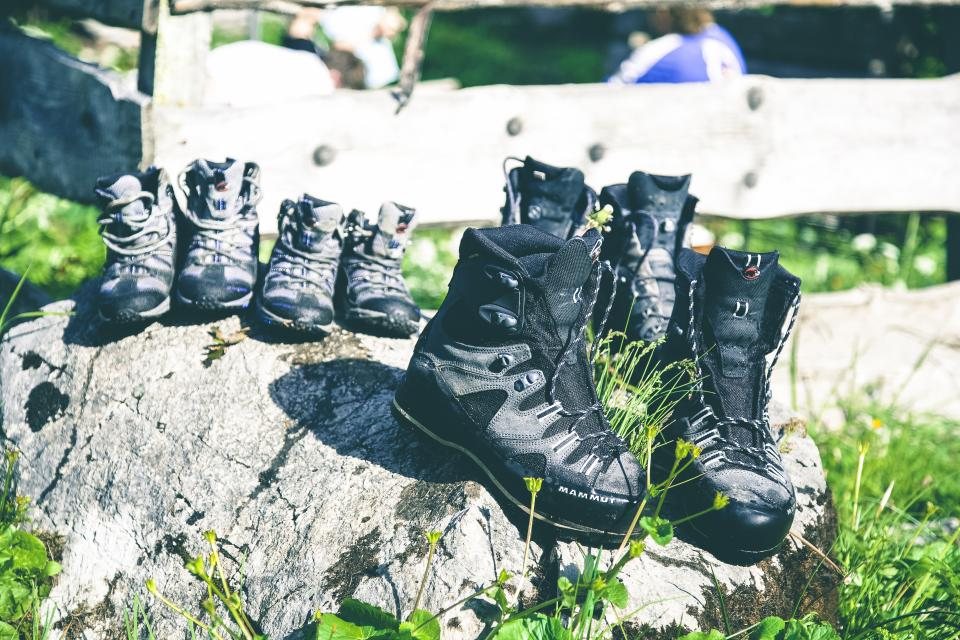
Trail shoes differ from road shoes in three ways: lugs of 3 to 6 millimetres for grip on soft ground, a firmer and often rock-plated sole to protect the foot from stones, and a snugger fit around the midfoot to stop the foot sliding on descents. For dry, hard-packed trails a road shoe will do for the first few runs; for mud, wet grass or rocky ground, proper trail shoes are worth having early. Hiking boots are too heavy and too stiff to run in comfortably.
- A running vest or belt with 500 millilitres to a litre of water for outings over an hour.
- A windproof or waterproof jacket that packs small, always, whatever the forecast.
- A phone with the route downloaded and a small paper map of the area.
- Food for anything over 90 minutes: a bar or a handful of dried fruit is enough.
- A whistle, a foil blanket and a few plasters, which weigh almost nothing.
- Poles, optional but useful, once we start running routes with more than 500 metres of climb.
Building up without breaking down
Trail running loads the ankles, calves and stabiliser muscles in ways that walking and road running do not, and the most common beginner problem is doing too much too soon. A sensible start for a fit hiker is one or two runs a week of 30 to 45 minutes on easy paths, with plenty of walking, and a total weekly running time that grows by no more than 10 percent from one week to the next. A first “long” trail run of 90 minutes with 300 to 400 metres of climb is a realistic goal after six to eight weeks.
Recovery matters as much as the runs. Calves and Achilles tendons adapt slowly, so we give them easy days and short walks between runs. A few minutes of single-leg balance work in the kitchen each evening does more for ankle stability than any piece of equipment.
Sharing the trail
Runners are faster than everyone else on the path and it is our job to be considerate. We slow down and call out well before passing walkers, we give way to anyone coming uphill, and we stop entirely for horses and for families with small children. On narrow single track, we step off the path on the downhill side to let others through. We stay on marked trails, leave gates as we found them, and take our gel wrappers home. A friendly word as we pass costs a second and keeps the trails welcoming for everyone.
The reward for all this is the feeling that a hiker knows but a runner feels more intensely: the moment the path opens onto a ridge and we realise we have covered in an hour what used to take a morning, and that we still have the whole afternoon ahead of us.