
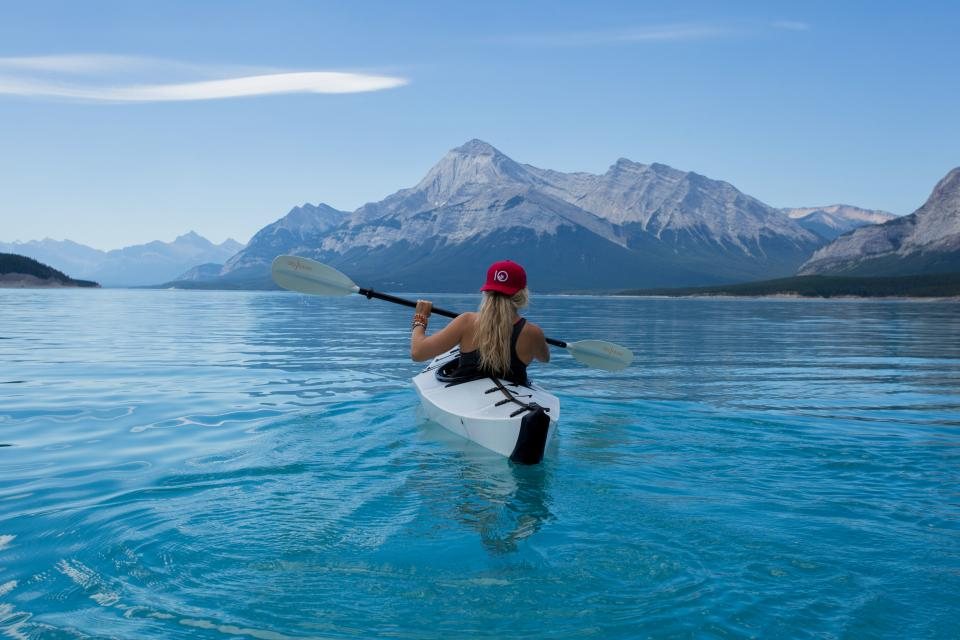
Sea kayaking has a reputation for drama: long crossings, big swell, expedition photos with icebergs in the background. The reality of a first season is far gentler. Most of us start in a sheltered bay, on a calm morning, within a few hundred metres of the beach we launched from. That is exactly where the sport should begin, and it is where the habits that keep us safe for years are formed. This guide covers the three things a beginner needs to understand before that first paddle: the boat, the tide, and how to choose a day and a place that forgive mistakes.
What makes a sea kayak different
A sea kayak is long, narrow and closed. Typical touring boats run from 4.5 to 5.5 metres, with a cockpit we sit inside and bulkheads that create sealed compartments at the bow and stern. Those compartments do two jobs: they store gear for a day out, and they keep the boat floating high if the cockpit fills with water. A recreational kayak, the short open boat found at many rental beaches, has neither the length nor the buoyancy for open water, and we should not take one onto the sea beyond a quiet cove.
Length gives tracking, the tendency to hold a straight line. Width gives initial stability, the reassuring feeling that the boat does not want to tip. Beginners usually prefer a boat around 58 to 62 centimetres wide. Many sea kayaks also have a skeg or a rudder, a retractable fin that helps the boat resist being pushed sideways by wind.
Two pieces of equipment are not optional. A buoyancy aid, sized so it cannot ride up over our head, must be worn and fastened every time. A spray deck, the neoprene or nylon skirt that seals the cockpit, keeps waves out but also traps us in, so we practise releasing it by pulling the grab loop before we ever paddle away from the beach.
Understanding the tide before you launch
On most coasts the sea rises and falls twice a day, on a cycle of roughly twelve hours and twenty-five minutes. The difference between high and low water is the tidal range, and it varies enormously: under a metre in parts of the Mediterranean, several metres on Atlantic coasts, and more than ten metres in a few famous estuaries and bays. For a beginner, range matters because it changes the beach. A launch spot that is a short carry at high water can be a 300 metre walk over mud or rocks at low water, and a boat left at the waterline can float away while we eat lunch.
Moving water matters even more. As the tide rises and falls, water flows through channels, around headlands and past islands. This tidal stream is strongest in the middle hours between high and low water and weakest near the turn, a pattern often described as the rule of twelfths. A stream of two knots, common near headlands, is faster than most beginners can paddle for long. The first lesson is simple: check the tide times and the tidal range for the day, and plan to be on the water around slack water, close to high or low tide, when the stream is weakest.
Choosing a sheltered place
Shelter is about wind and swell. A bay that opens away from the prevailing wind, with land on three sides, is the ideal classroom. Inside such a bay the water stays flat even when whitecaps are visible further out. Sea lochs, fjords, estuaries above the mouth, and the lee side of islands all offer the same protection. We avoid headlands, where wind and tide meet and the sea becomes confused, and we avoid river mouths and harbour entrances, where currents and boat traffic combine.
A good first venue also has an easy exit. We look for a gently sloping beach of sand or fine shingle, a place to land every few hundred metres along the shore, and a car park or path close to the water. If anything goes wrong, we want to be able to paddle to land in minutes, not an hour.
Reading the forecast
Wind is the beginner’s main enemy. Below force three, about 12 to 19 kilometres per hour, a sheltered bay stays calm and a novice paddler makes progress in any direction. At force four, 20 to 28 kilometres per hour, small waves appear and paddling into the wind becomes real work. Above that, we stay ashore. Direction matters as much as speed: an offshore wind feels gentle on the beach but pushes us out to sea and grows stronger as we leave the lee of the land. An onshore wind of the same strength pushes us home. For a first season, we paddle only when the wind is onshore or along the shore, and only when the forecast for the next six hours is stable.
We also check the swell forecast, expressed as height in metres and period in seconds. A long-period swell of even one metre can break heavily on an exposed beach and be invisible in the bay. Water temperature completes the picture. Below 15 degrees Celsius, an unplanned swim becomes serious within minutes, and a wetsuit or drysuit is part of the kit, not an accessory.
The first hour on the water
We launch from the beach, not from a jetty, and we practise within swimming distance of the shore for the whole first session. The order matters:
- Sit in the boat on the sand, fit the spray deck, release it, refit it, until it is automatic.
- Float in waist-deep water and practise a wet exit: capsize, pull the loop, push out, surface holding the paddle and the boat.
- Learn the forward stroke with a straight back and rotating torso, then the sweep stroke to turn.
- Practise stopping and reversing, and paddling in a straight line toward a fixed point on shore.
- Try an assisted rescue with a partner: emptying a flooded boat and climbing back in over the stern.
Sea kayaking rewards patience: the boat feels tippy on day one and solid by day three, and the rescue skills learned in calm water are the ones that matter on the day the wind changes early.
Building toward real trips
After three or four sheltered sessions, we extend the range: a paddle to the far side of the bay and back, perhaps five or six kilometres, then a short coastal hop between two beaches on a calm day at slack water. A relaxed touring pace is about four to five kilometres per hour, so a ten kilometre day is a comfortable two to three hours with a lunch stop. We tell someone ashore our plan and our return time, we carry a phone in a waterproof case and a whistle on the buoyancy aid, and we never paddle alone in the first season.
A structured introductory course, usually two days, teaches the rescues and the tidal planning properly and is the best investment a beginner can make. From there the coast opens up, one sheltered bay at a time.